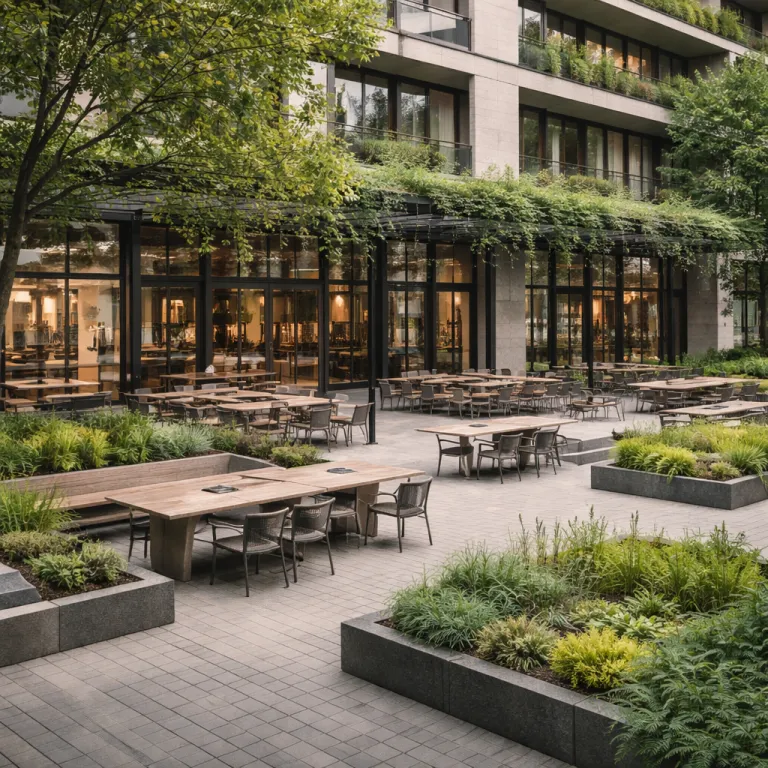
The restaurant as placemaking engine, not hotel amenity
Hotel restaurant trends have shifted the restaurant from amenity to anchor. In the hospitality industry, the most competitive hotels now treat F&B as placemaking infrastructure that shapes the entire guest experience and the perception of the property in its city. When 60 % of luxury travelers say they prioritise staying in a hotel with a great restaurant (Hospitality Net, “Luxury Traveller Dining Preferences,” 2023, survey of self-identified luxury travellers in Europe and North America), the economic argument for this shift becomes impossible to ignore.
Across the hospitality sector, owners and asset managers see that a strong restaurant industry positioning drives both room revenue and non resident covers. A 2022 internal analysis by Accor, summarised in its “F&B Performance Review 2022” for a sample of European upscale and luxury properties, found that hotels with clearly defined, locally relevant restaurant concepts recorded around 30 % more five star dining reviews than comparable hotels with generic outlets over a 12 month period, which correlated with higher ADR and more stable occupancy. This is not abstract ; it is the difference between a restaurant that quietly serves in house travelers and one that becomes a reference point in the local dining scene, as seen at venues like The Hoxton, Southwark’s Albie or The Ned’s Cecconi’s in London.
In practice, these hotel restaurant trends mean the restaurant must compete credibly with independent restaurants within a 15 min walk. The hospitality teams that win are creating immersive experiences that blend local food culture, design and service theatre into a coherent narrative that feels authored, not templated. As one F&B director at The Hoxton Paris noted in a 2023 industry roundtable, the brief is to build “a restaurant locals would book even if the hotel disappeared tomorrow.” For the guest, the restaurant becomes the first touchpoint of the overall customer experience, often more influential than the spa or even the room product.
Industry trends show that restaurants and bars now function as third spaces where remote work, casual meetings and social dining overlap throughout the day. This shift in guest experiences requires rethinking cover counts, zoning and daypart programming so that the same square metres can host laptop friendly coffee service at 10.00 and high energy aperitivo at 19.00. When the hospitality industry treats the restaurant as a flexible social infrastructure rather than a fixed meal period venue, both revenue management and brand equity benefit.
For C suite leaders, the strategic question is no longer whether to invest in food and beverage, but whether the concept is strong enough to define the hotel’s position in its market. A restaurant that attracts local guests at scale creates an eco friendly halo of authenticity and reduces reliance on transient travelers alone. The most advanced hotels now read their restaurant P&L as a city relevance report, not just an outlet level industry report, tracking metrics such as local guest mix, repeat visits and review sentiment alongside traditional profitability indicators.
Designing third spaces that work from breakfast to late night
Third space design in modern hotels starts with a hard look at cover allocation by daypart, not with mood boards. Successful concepts treat the lobby, bar and restaurant as one integrated hospitality ecosystem where guest experience flows seamlessly from coffee to cocktails to late night snacks. The aim is creating immersive experiences that feel natural to both in house guests and locals who may never see a guest room.
Operationally, this means planning for at least three distinct experiences in the same footprint across the day. Breakfast might prioritise hotel guests with a high quality buffet and à la carte plant based options, while lunch pivots to fast, business friendly dining that respects a 45 min dwell time. Evenings then shift toward destination restaurant energy, with the bar and restaurant working together to extend average check and length of stay without overwhelming the équipe, as seen at properties like The Standard, London, where the lobby bar gradually morphs from co working hub to cocktail lounge.
Cover counts should be split deliberately between hotel guests and external guests, with clear revenue management targets for each segment. In many urban hotels, a 60 40 split in favour of locals at dinner service is now a realistic benchmark for restaurant industry success. When the restaurant consistently fills with local guests, the hotel benefits from a powerful marketing effect that no paid campaign can replicate, because every full dining room becomes a live advertisement for the property’s relevance in its neighbourhood.
Technology plays a quiet but decisive role in making these third spaces viable. Mobile ordering and QR based menus can handle low complexity items in the bar zone, freeing staff to focus on high touch tables in the main dining room where memorable experiences are created. Real time data from the POS and reservation systems allows managers to adjust seating plans, staffing levels and menu engineering on the fly, improving operational efficiency without sacrificing hospitality.
As remote work patterns reshape how travelers and locals use space, hotels that provide comfortable, well serviced third spaces during off peak hours will continue to capture incremental revenue. Guests who spend the afternoon working in the lobby bar are more likely to stay for aperitivo and then transition into the restaurant, turning a single coffee into a full evening of guest experiences. In this model, the restaurant is not just a meal venue ; it is the anchor of a full day customer experience strategy.
Concept authorship, local relevance and the economics of personality
The most resilient hotel restaurant trends share one trait : clear authorship. Personality led concepts, often driven by a named chef or a strong culinary director, outperform generic brand templates in both guest satisfaction and financial metrics. MICHELIN’s recent emphasis on cultural clarity and narrative in its 2023 and 2024 guides only reinforces this direction, rewarding restaurants that express a specific point of view rather than a safe international blend.
For hotel groups, this raises a strategic choice between rolling out a standardised restaurant brand and empowering local teams to create a concept rooted in the local food culture. A locally authored restaurant can integrate regional producers into the supply chain, reduce transport emissions and present a more environmentally friendly story to increasingly eco conscious guests. When this local narrative is authentic, it translates into higher per cover spend because guests are buying into a place specific experience, not just a meal, as illustrated by venues like Seta at the Mandarin Oriental, Milan, which foregrounds Lombard producers and seasonal Italian ingredients.
From an industry report perspective, the economics of authorship show up in review scores, repeat visits and ancillary revenue. Properties that invest in creating immersive, story driven restaurants often see an ADR premium justified by the elevated guest experience and the halo effect on the hotel’s perceived status. Bars and breakfast also benefit, as travelers who trust the restaurant’s culinary leadership are more willing to try signature cocktails, tasting menus and premium breakfast options.
There is, however, an operational tax to running a true destination restaurant inside a hotel. Staffing requirements are higher, training is more intensive and the coordination between rooms division and F&B must be tighter to protect both guest experiences and operational efficiency. Artificial intelligence tools can support menu planning and forecasting, but they do not replace the need for a highly skilled équipe that can execute consistently at volume and maintain the personality of the concept during busy services.
Technology should be used to enhance, not dilute, the authored concept. AI driven menu engineering can analyse real time sales data and food cost to suggest which plant based dishes or local specialties deserve more prominence, while still leaving creative control with the chef. When used intelligently, artificial intelligence becomes a backstage tool that supports both revenue management and the integrity of the restaurant’s narrative.
Data, technology and the new F&B performance playbook
Hotel restaurant trends are increasingly shaped by data, not just by intuition. According to a 2023 Hospitality Net survey on “AI Adoption in Hotel F&B,” around 45 % of hotels in its global respondent pool reported adopting some form of AI in dining services, and those that personalise dining experiences reported revenue uplifts of roughly 20 % in tracked pilot outlets (Hotel Management, “Personalised F&B Revenue Impact,” 2022, based on case studies from full service urban hotels). These are not marginal gains ; they redefine what a high performing F&B department looks like in a competitive urban market.
For F&B directors, the priority is to translate this data into concrete decisions that improve both customer experience and profitability. AI driven tools can forecast demand by daypart, optimise staffing min and suggest menu adjustments based on real time guest feedback and sales patterns. When combined with disciplined revenue management, this allows restaurants to balance occupancy, average check and labour cost with far greater precision.
Guest facing technology also reshapes how experiences are delivered. Mobile pre ordering for breakfast can smooth peak periods, while digital waitlists reduce friction for walk in guests at popular restaurants that serve both hotel guests and locals. When technology removes low value friction points, staff can redirect their energy toward creating memorable experiences at the table, where hospitality still depends on human judgement and empathy.
Sustainability expectations add another layer of complexity to the F&B performance playbook. Guests increasingly look for eco friendly and environmentally friendly choices, from plant based menu items to visible efforts to reduce waste and shorten the supply chain. Hotels that integrate these practices into their restaurant concepts, rather than treating them as add ons, strengthen both their brand and their appeal to high value travelers.
Ultimately, the winning hospitality teams will continue to be those that combine rigorous data use with a strong point of view on food and experience. Technology, whether in the form of artificial intelligence, mobile ordering or advanced kitchen equipment, is a means to support the craft of hospitality, not a replacement for it. When data, design and human service align, hotel restaurants stop being cost centres and become the most powerful placemaking assets in the property.
Key figures shaping hotel restaurant trends
- 45 % of hotels have adopted AI in dining services, indicating rapid technology integration across the hospitality industry to support forecasting, menu planning and operational efficiency (Hospitality Net, “AI Adoption in Hotel F&B,” 2023, based on a voluntary online survey of hotel executives).
- Personalised dining experiences have generated an estimated 20 % increase in F&B revenue for participating hotels, showing that tailored guest experiences translate directly into higher spend per cover (Hotel Management, “Personalised F&B Revenue Impact,” 2022, analysis of selected urban full service hotels over 6 to 12 months).
- Approximately 60 % of luxury travelers now prioritise staying in hotels with great restaurants, which positions F&B as a primary decision factor rather than a secondary amenity (Hospitality Net, “Luxury Traveller Dining Preferences,” 2023, survey of luxury travellers booking four and five star properties).
- F&B forward properties in a 2022 Hospitality Net aggregated analysis reported roughly one third more positive online restaurant reviews than comparable hotels, which in turn supported higher ADR and occupancy (Hospitality Net, “F&B Forward Hotel Performance,” 2022, review of mixed brand city hotels in Europe and North America).
Questions executives ask about hotel restaurant trends
What are the latest trends in hotel dining?
The latest hotel dining trends include sustainable sourcing, personalised menus and deep integration of technology across the guest journey. Sustainable sourcing now means building shorter, more resilient supply chains with local producers and transparent communication about origin and waste reduction. Personalised menus, often supported by AI driven tools, allow hotels to adapt offers to dietary preferences and spending patterns while maintaining a coherent restaurant identity.
How are hotels enhancing guest dining experiences?
Hotels are enhancing guest dining experiences by designing restaurants and bars as third spaces that serve multiple purposes throughout the day. Interactive and culturally immersive experiences, such as chef’s counters, live cooking stations or collaborations with local artisans, create stronger emotional connections and justify higher average checks. Technology supports this by simplifying reservations, enabling pre ordering and capturing feedback that can be used to refine concepts over time.
Why is technology important in hotel restaurants?
Technology is important in hotel restaurants because it streamlines operations and frees staff to focus on high value interactions. From mobile ordering and digital payment to AI based forecasting and menu engineering, these tools reduce friction for guests and improve cost control for operators. When implemented thoughtfully, technology enhances the guest experience instead of replacing human hospitality, which is critical for destination restaurants inside hotels.
How can hotel restaurants balance local appeal with brand standards?
Balancing local appeal with brand standards requires clear guardrails on quality, safety and service, combined with freedom for local teams to express regional food culture. Many successful hotel groups define non negotiable brand pillars, such as breakfast quality or sustainability commitments, while allowing chefs to design menus and experiences that resonate with local guests. This approach preserves brand consistency across hotels while ensuring each restaurant feels relevant in its own city.
What role does sustainability play in modern hotel restaurant concepts?
Sustainability now plays a central role in modern hotel restaurant concepts, influencing menu design, sourcing, equipment and waste management. Guests increasingly expect eco friendly and environmentally friendly practices, from plant based options to visible recycling and energy efficient kitchens. Hotels that embed these principles into their F&B strategy, rather than treating them as marketing slogans, build stronger trust and long term loyalty among both travelers and local diners.